By Clara Reed
AWS is extending Amazon GuardDuty beyond conventional cloud workload monitoring with a new AI Protection capability designed to identify threats aimed specifically at artificial intelligence services. Announced on July 14, 2026, the feature covers Amazon Bedrock and Amazon SageMaker, giving security teams a dedicated way to monitor activity around models, AI services and the applications built on top of them.
The launch addresses a practical problem for organizations moving AI workloads into production: the events that matter most may not look like traditional infrastructure attacks. An unusual model invocation, a sudden increase in token or GPU consumption, or an instruction designed to manipulate an AI workflow can be difficult to distinguish from legitimate activity when security teams are relying only on conventional cloud monitoring.
What AWS is adding
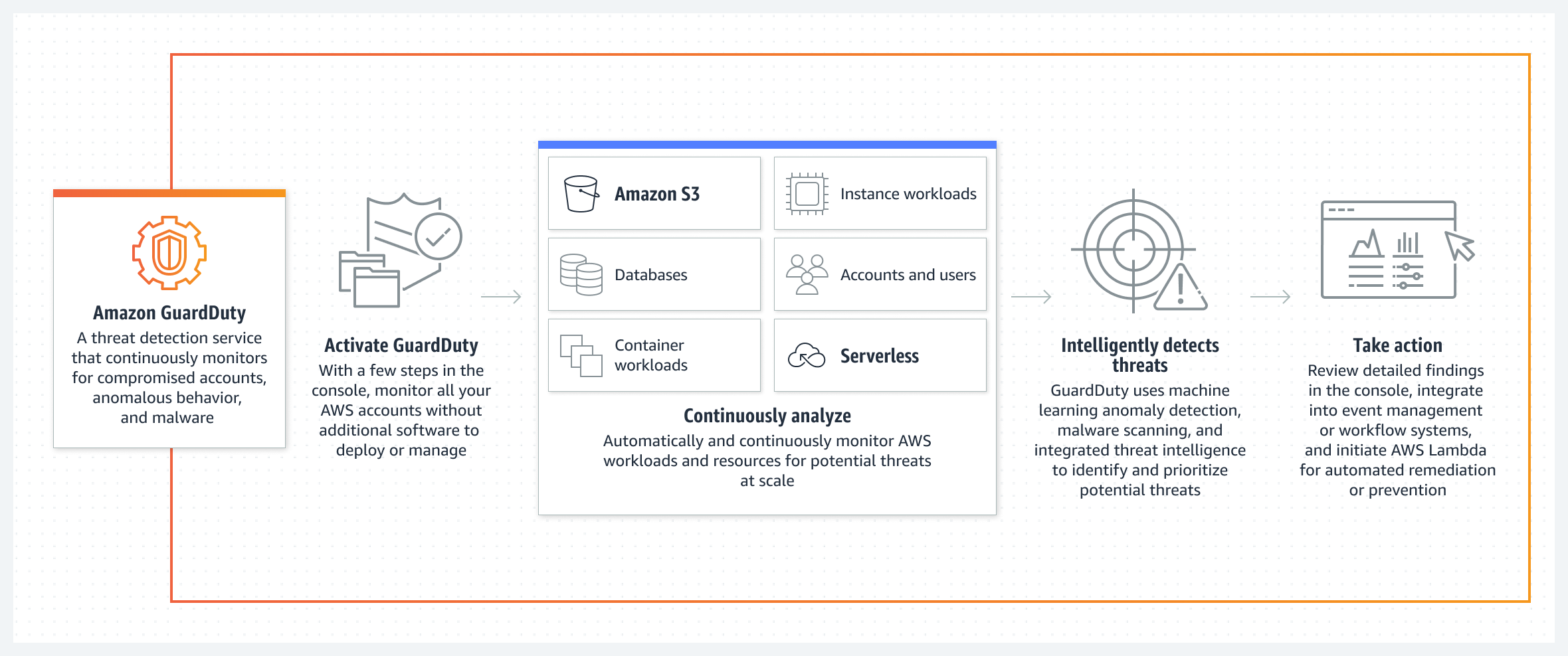
AWS says GuardDuty AI Protection continuously monitors AI workloads and analyzes both CloudTrail management events and data events from AWS AI services. That gives the service visibility into administrative changes as well as activity associated with the use of AI resources. The stated goal is to detect suspicious behavior without requiring customers to build separate monitoring rules or custom tooling for every AI deployment.
The coverage announced by AWS includes Amazon Bedrock and Amazon SageMaker. Bedrock is used to build generative AI applications and agents, while SageMaker supports the development and deployment of machine learning workloads. In practice, that means the security boundary is not limited to a single model endpoint. It includes the surrounding services and activity that help an organization operate AI systems in AWS.
AWS has not presented AI Protection as a replacement for identity controls, application security or model governance. Instead, the announcement positions it as an additional detection layer for teams that need to understand what is happening inside their AI estate and connect that activity to their existing cloud security operations.
Detection focuses on AI-specific abuse
The feature is intended to identify several categories of behavior that are especially relevant to AI workloads. AWS cites anomalous model invocation patterns, which could indicate misuse of credentials, unauthorized automation or an application behaving outside its expected profile. Monitoring this activity at the service level can help teams investigate whether an unusual request is a configuration issue or part of a broader compromise.
AWS also highlights cost harvesting attacks. In this scenario, an attacker forces AI resources to consume excessive GPU time or tokens, potentially turning a compromised account into an expensive compute target. The announcement does not claim that every unexpected increase in usage is malicious. It does indicate that unusual consumption is one of the signals GuardDuty AI Protection is designed to examine.
The third example is prompt injection. AWS says GuardDuty AI Protection can identify prompt injection attempts through integration with Amazon Bedrock Guardrails. This matters because an attack may begin with content sent to an AI application rather than with a conventional network intrusion. A prompt or retrieved document can attempt to alter an agent's behavior, expose information or induce actions that were not intended by the application owner.
Findings move into Security Hub
When GuardDuty AI Protection identifies suspicious activity, its findings flow into AWS Security Hub. That integration gives security teams a central place to review AI-related signals alongside other findings from the AWS security stack. The operational benefit is less about creating another dashboard and more about putting AI events into the same prioritization and response process already used for cloud infrastructure.
AWS says customers can enable the capability through the GuardDuty or Security Hub console. Organizations using AWS Organizations can also enable it centrally across accounts. That option is important for companies whose AI workloads are distributed across development, testing and production accounts, where a local configuration may otherwise leave gaps in visibility.
The service is available to GuardDuty customers with a 30-day free trial. AWS directs customers to its pricing information and regional services list for the commercial and geographic details that apply to their environment. Those details should be checked before assuming that the capability is available in every account or region.
Why the announcement matters
AI security is increasingly becoming an operations problem as much as a model-quality problem. Teams need to know which AI services are being called, by which identities, at what volume and under what conditions. A model can be working as designed while the surrounding access pattern is not. Conversely, an alert about an unusual invocation may require application context before it can be treated as an incident.
GuardDuty AI Protection reflects that shift by treating AI activity as a security telemetry category in its own right. Its use of CloudTrail data connects service events to established AWS audit records, while the Security Hub integration gives those findings a route into triage and response workflows. This should make the feature most useful to organizations that already operate centralized cloud security processes and want AI workloads to participate in them.
There is also a governance implication. As teams deploy agents and model-powered applications, security policies must cover not only human users and machines but also the actions initiated through AI services. Detecting unusual calls, excessive consumption and injection attempts does not remove the need for least-privilege permissions or application-level validation, but it can make deviations easier to surface.
What security teams should verify
Before relying on the new capability, teams should map their Bedrock and SageMaker usage to the accounts, identities and applications that are expected to generate activity. That baseline is necessary for distinguishing a legitimate change in workload from an event that deserves investigation. It is also worth confirming how findings will be routed, who owns first review and which response actions are safe to automate.
Security teams should separately review permissions for AI services, limits on consumption and the guardrails applied to model interactions. GuardDuty AI Protection is described by AWS as a detection capability, not as a complete AI security program. It can provide signals, but teams still need controls that restrict access, protect sensitive data and prevent an agent from taking actions beyond its intended scope.
The announcement is therefore significant without being a promise of automatic protection for every AI risk. AWS is adding AI-aware detection to a widely used cloud security workflow, with coverage for specific services and threat patterns. Its value will depend on how well organizations connect those findings to identity management, application context and a tested incident-response process.
For organizations already running AI workloads on AWS, the launch offers a new way to bring model and agent activity into routine security monitoring. The immediate next step is not to assume that every alert represents an attack, but to establish a clear baseline, enable the capability where supported and determine how AI-specific findings will be investigated alongside the rest of the cloud environment.
Read AWS's official announcement for the stated coverage, enablement options and links to the relevant documentation.