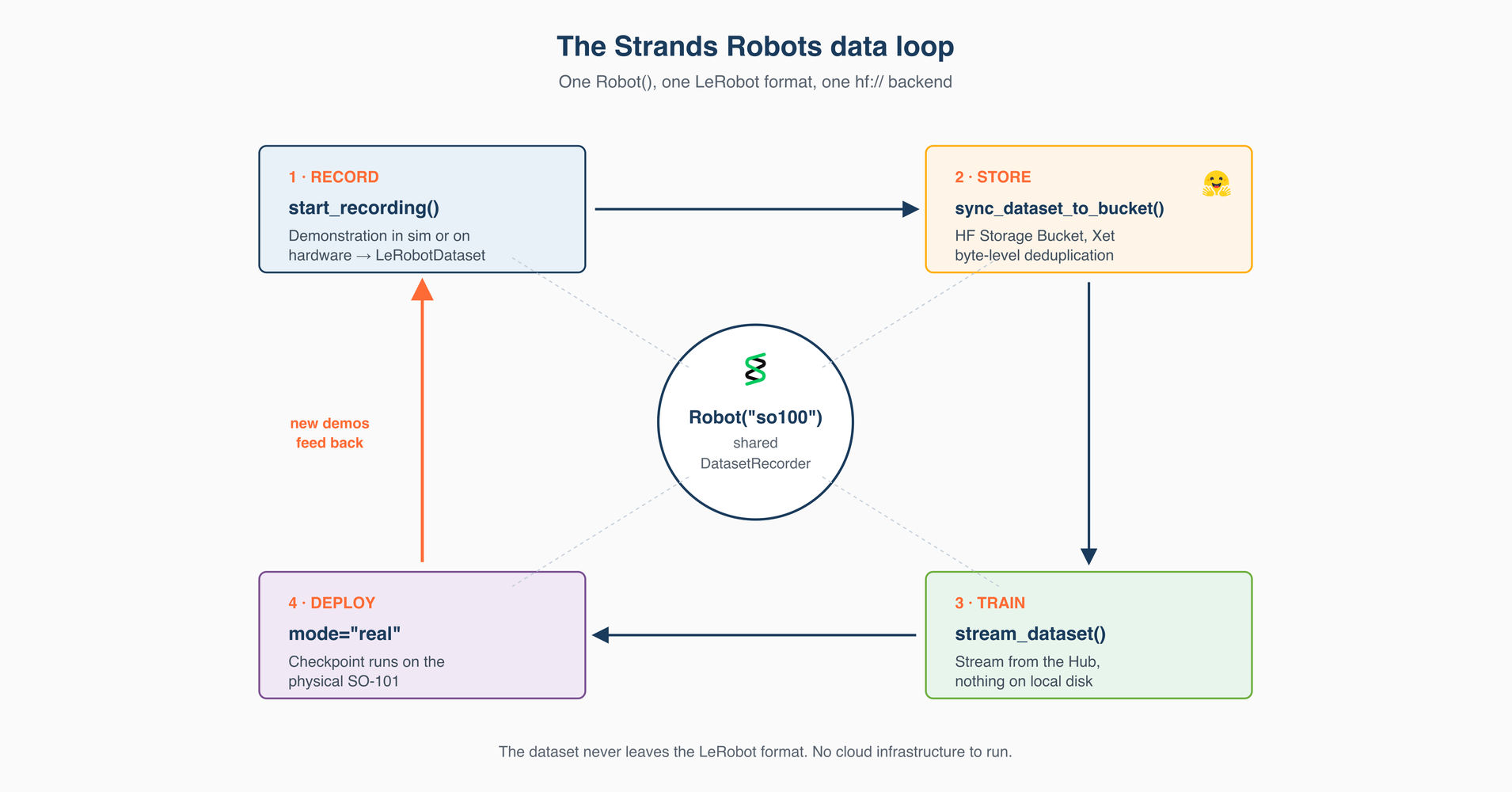
AWS has outlined a streaming data loop for Strands Robots that links robot demonstration recording, policy training and deployment. The workflow is described in a Hugging Face post dated August 13, 2026, with one practical objective: keep the recorded data usable at every stage without requiring a separate conversion step.
A single format links the workflow
Strands Robots is presented as an open-source AWS SDK released under the Apache 2.0 license. Its recorder stores each run as a dataset in LeRobot format, allowing compatible tools to read the result directly. AWS says the format is already used by more than 90,000 datasets and models on the Hub from more than 8,000 publishers. That gives the SDK a broad compatibility target instead of introducing a format specific to one recording pipeline.
The storage layer is Hugging Face Storage Buckets, described as mutable, unversioned object stores backed by Xet. Buckets share the hf:// namespace with dataset repositories and are accessed through the hf command-line interface. The sync_dataset_to_bucket function writes a run to hf://buckets/{bucket}/{run_id}. If no run ID is supplied, it uses the dataset directory name by default.
Experiments stay mutable; publications get versions
The workflow draws a clear line between working data and a dataset prepared for publication. A bucket is the mutable layer for ongoing runs, while push_to_hub() sends the resulting data to a versioned dataset repository. This separation suits experiments that are still changing while preserving a distinct destination for data intended to be shared.
Xet also reduces repeated transfers through byte-level deduplication and content-dependent chunking. Hugging Face reports that the approach reduced transferred data by about a factor of four in its Hub measurements. On Enterprise plans, billing is based on the deduplicated footprint. In the cited benchmark, modifying 1%, 5% or 10% of an original 500 MB file resulted in 5.5 MB, 27.5 MB or 55 MB transferred, respectively.
Streaming limits what remains on the local machine
The recorder splits data into Parquet shards and creates MP4 shards for each camera, using default thresholds of 100 MB for data and 200 MB for video. The stream_dataset function exposes a StreamingLeRobotDataset that decodes remote MP4 video as needed and reads state and action data from Parquet shards. Locally, the process keeps only the small meta/ directory, which contains the schema, statistics and episode index.
This behavior is also required by the trainer’s bucket mode: its configuration expects dataset.streaming=true and rejects bucket mode when streaming is disabled. The requirement makes the storage design part of the training path rather than an optional optimization.
The simulation proves the path, not the policy
In the default simulation path, the mock policy produces a structurally valid dataset, but not useful training data. A minimal run can therefore show that the recording, storage and training handoff work together without establishing that a learned robot policy will perform well.
That minimal simulation requires Python 3.12 or later on Linux or macOS, with Apple Silicon supported for the MuJoCo backend. Strands Robots’ stated value is the connected, LeRobot-compatible route from demonstrations to deployment, alongside lower duplicate-transfer overhead. The workflow does not measure the resulting policy quality; that outcome still depends on the demonstrations and the training process. For teams evaluating the SDK, the concrete benefit is a shared data path and smaller repeated uploads, while the quality of the final policy remains a separate question.