
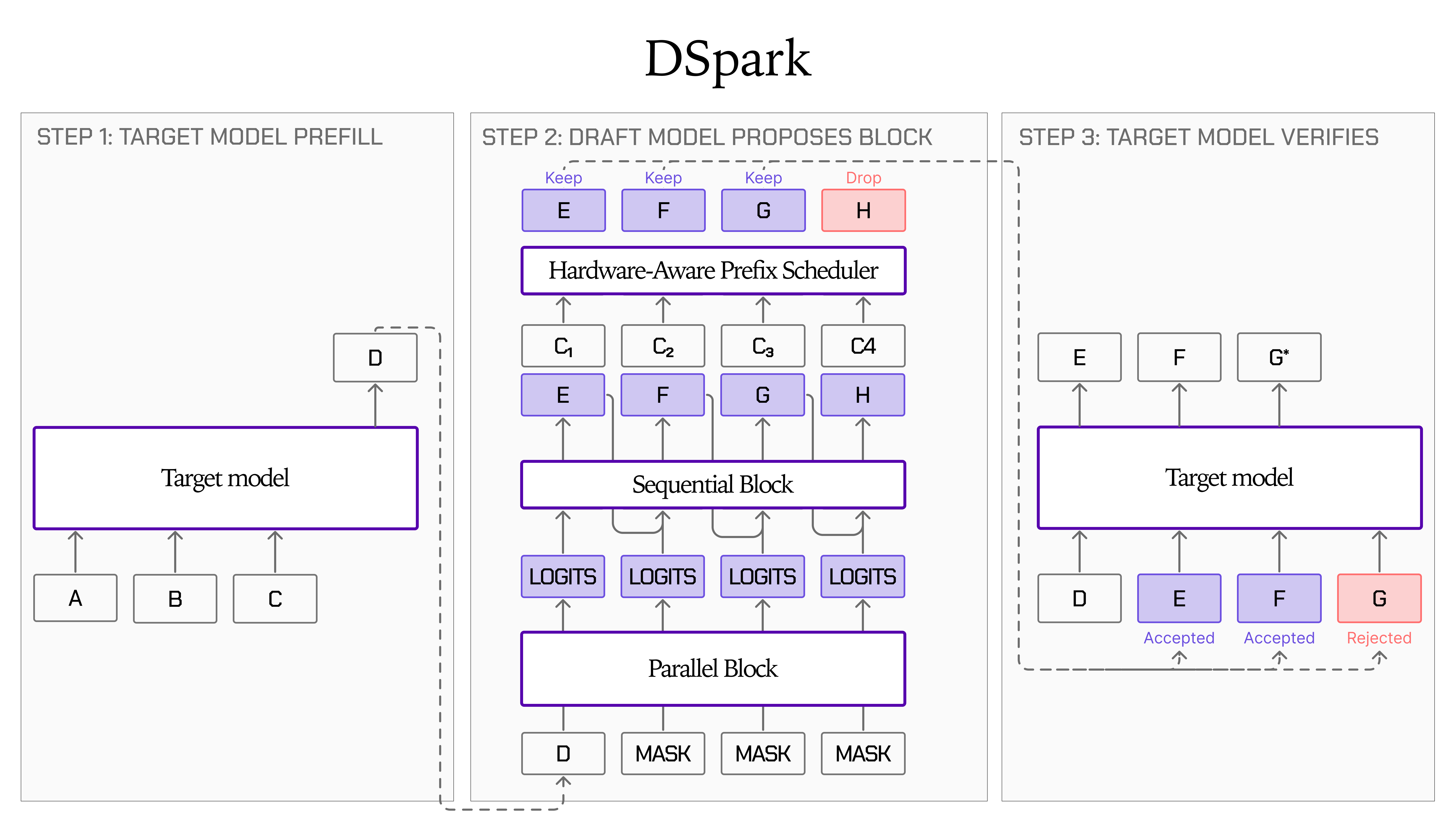
Liquid AI announced on August 20, 2026, that DSpark draft checkpoints are available for three models in its LFM2.5 family: LFM2.5-1.2B-Instruct, LFM2.5-2.6B and LFM2.5-8B-A1B. The release targets inference speed, particularly in workloads where models generate responses or make several tool calls.
According to Liquid AI’s announcement, DSpark adds a speculative decoding path that uses slightly more memory without changing output quality. The draft model proposes tokens, then the target model checks them. Under greedy decoding, Liquid AI says the resulting output is identical to that of the target model running alone. The change is therefore aimed at runtime performance rather than at changing the model’s answer.
The reported gains depend on the workload
Liquid AI reports maximum throughput improvements of 3.18 times on GPU and 2.87 times on device for the models covered by the release. For LFM2.5-2.6B, its published average gains are 2.67 times on an H100 and 2.27 times on a MacBook Pro with an M4 Max chip.
The company also reports an average 57% reduction in function-call latency for LFM2.5-2.6B across several scenarios involving multiple tools. For developers building applications around tool use, this is the clearest practical consequence in the announcement: a model can spend less time completing a sequence of calls. The figures come from selected test setups, however, and should not be treated as a universal speed guarantee.
How the DSpark path works
The approach combines a parallel DFlash-style backbone, a lightweight sequential head modeled as a Markov chain and a confidence-planning verifier. The first draft models are simplified, attention-only networks with five layers and a block of nine. Each contains roughly 300 million parameters: 295.7 million for LFM2.5-1.2B-Instruct-DSpark and 327.7 million for each of the other two draft models.
Liquid AI evaluated the system on MATH500, HumanEval, MBPP, GSM8K and MT-Bench, using a DSpark block size of nine, a batch size of one and zero temperature. Those details matter because the measured results are tied to a specific evaluation configuration rather than to an unspecified “faster” mode.
For LFM2.5-2.6B, the measurements used llama.cpp with Metal on the M4 Max MacBook Pro, with GGUF FP16 weights, and SGLang on an 80 GB H100, with BF16 weights. Liquid AI attributes part of the gap between GPU and device results for LFM2.5-8B-A1B to llama.cpp’s current Metal implementation and the extra weight traffic created by its experts.
Support starts with llama.cpp and SGLang
DSpark checkpoints are available on Hugging Face in Safetensors and GGUF formats for all three models. Liquid AI says integration is included at launch in llama.cpp and SGLang. Its examples use the DSPARK speculative algorithm in SGLang and the draft-dspark speculative type in llama.cpp, with separate target and draft files.
For LFM2.5 users, DSpark offers a faster inference route with a modest memory trade-off. The published results provide useful reference points for an H100 and an M4 Max MacBook Pro, while the engine, hardware and implementation details leave room for different results elsewhere. The main change is operational: the target model remains responsible for checking the output, while a smaller draft model helps keep generation moving.