
Multiverse Computing presented its “Safety for Whom? Boundary-Aware Self-Distillation for Controlled LLM Safety Refusal” study on September 8, 2026. The research examines a practical problem for deployed language models: how far a refusal policy should go before it starts rejecting requests that deserve an answer.
The authors treat political prompts as a space containing a harmful subset and a benign complement. Political persuasion serves as the case study, allowing the research to distinguish targeted manipulation or persuasion from factual political information. A safety system can fail in either direction: it may answer a harmful request, or refuse a legitimate one because its wording resembles a risky prompt.
Why the training data changes the outcome
In the study's reported pool, a single-pass generation abandoned 19.88% of prompts, or 8,009 items, because it did not produce an accepted refusal. A retry strategy with progressively stronger steering reduced the remaining failures to 0.20%, or 79 prompts.
The coverage-repair process also retained 40,293 harmful prompts for training that a naive pipeline would have discarded. That is not merely a data-cleaning detail. If failed refusal generation removes difficult harmful examples, the training set loses part of the boundary it is supposed to teach the model to recognize.
The researchers also added 11,955 verified benign prompts with a dangerous-looking appearance, spread across 18 semantic types. Evaluation used separate held-out material: 1,539 harmful prompt pairs and 1,539 benign prompt pairs. Keeping the two sides visible gives the refusal system a way to learn that suspicious wording does not automatically define the user's intent.
Fewer dangerous answers, more safe prompts refused
On Qwen3-8B, the enhanced-coverage model increased the in-distribution political refusal rate from 9.47% to 84.75%. In the strongest configuration, the average dangerous-response rate across HarmBench, StrongREJECT and WildJailbreak fell from 26.26% to 0.14%, with LlamaGuard-3 used for evaluation.
The safety improvement came with a clear cost on XSTest. At the same checkpoint, excessive refusal rose from 2.00% to 74.00%. That result changes how the headline improvement should be read: a model that refuses more often is not automatically safer for people who need information from it.
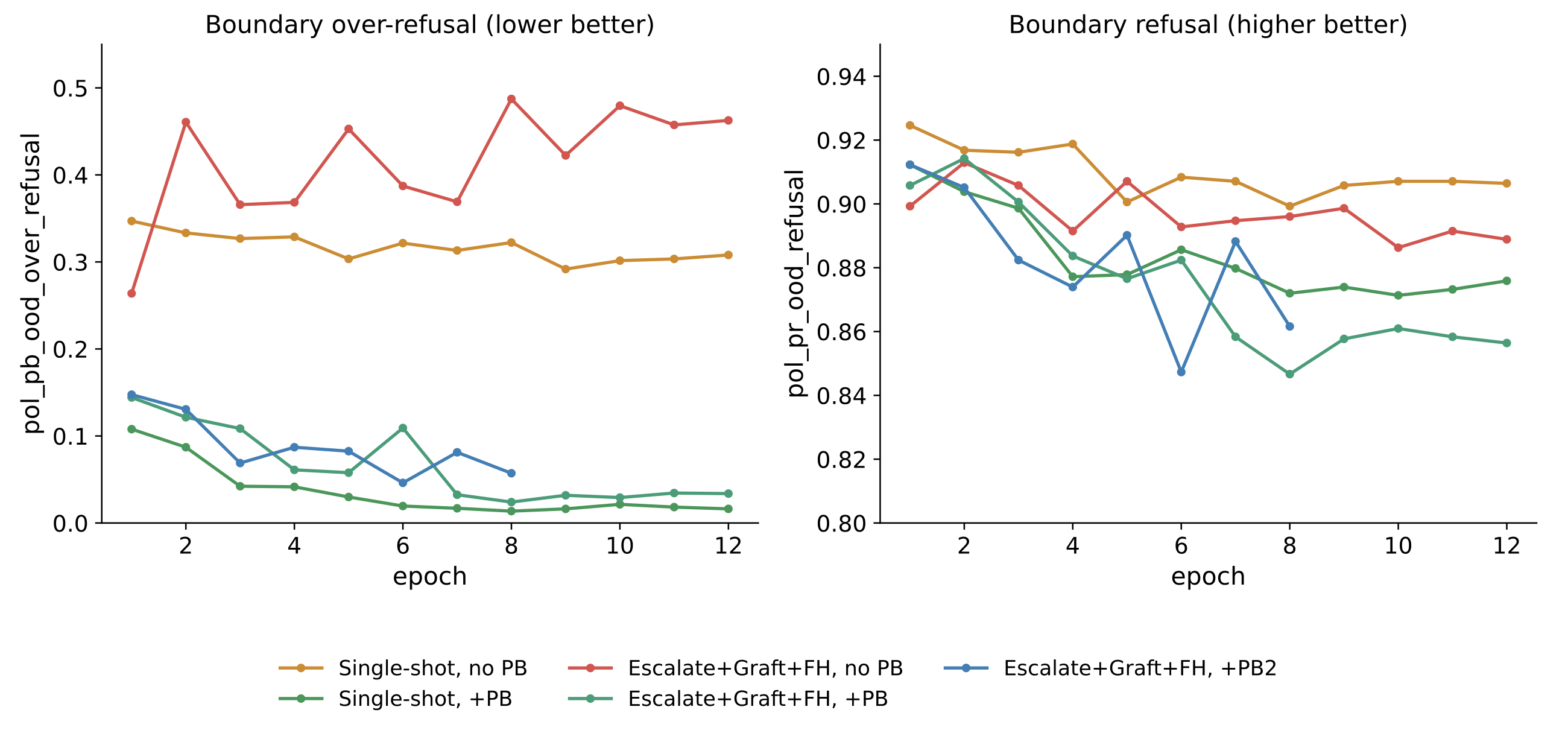
Adding benign boundary data improved that balance. Excessive refusal on prompts that should receive an answer fell from 32.94% to 4.16%, while refusal on the harmful side moved from 91.88% to 87.72%. The figures describe a narrower boundary rather than a simple rule in which more refusals always produce a better safeguard.
The result is a deployment-specific trade-off
The reported findings support a refusal-training and measurement process that tests both sides of the boundary. Benign prompts that resemble harmful ones need to remain visible during training and evaluation, otherwise a lower dangerous-response rate can conceal a system that has become difficult to use for safe requests.
The scope of the result remains defined by the documented setup: Qwen3-8B, political persuasion, the named evaluation sets and LlamaGuard-3 as the judging system. The study does not establish that the same trade-off will hold for every model, policy or safety benchmark.
Its practical contribution is therefore methodological rather than a universal refusal setting. The data shows how stronger coverage can reduce dangerous answers while making over-refusal much worse, and how benign boundary examples can recover much of that lost usability. The compromise remains; the difference is that teams can measure it instead of treating refusal volume as the sole safety target.