
NVIDIA has announced Medical Physics Simulation, an open-source framework for GPU-accelerated medical physics simulation integrated with NVIDIA Isaac for Healthcare. It targets medical-robotics developers who need to model interactions between anatomy and devices before moving to hardware tests.
The framework is built for scenarios that are difficult to capture in real-world data. Developers can use those simulations to test robotic systems in silico, then train or evaluate robotic policies before major hardware trials. That moves part of the development cycle into a controlled virtual environment, where more variations can be explored before equipment is involved.
Parallel simulation drives the performance claim
Medical Physics Simulation can run hundreds of environments in parallel. NVIDIA cites a benchmark involving 8,192 robotic-training environments running with native GPU simulation. In that test, training time fell from more than five hours to less than two minutes.
That figure comes from NVIDIA rather than an independent test, so it should be read as a reported benchmark instead of a general performance guarantee. It nevertheless shows why simulation scale is central to the announcement: running many environments at once could let developers evaluate more training scenarios before committing to large hardware tests.
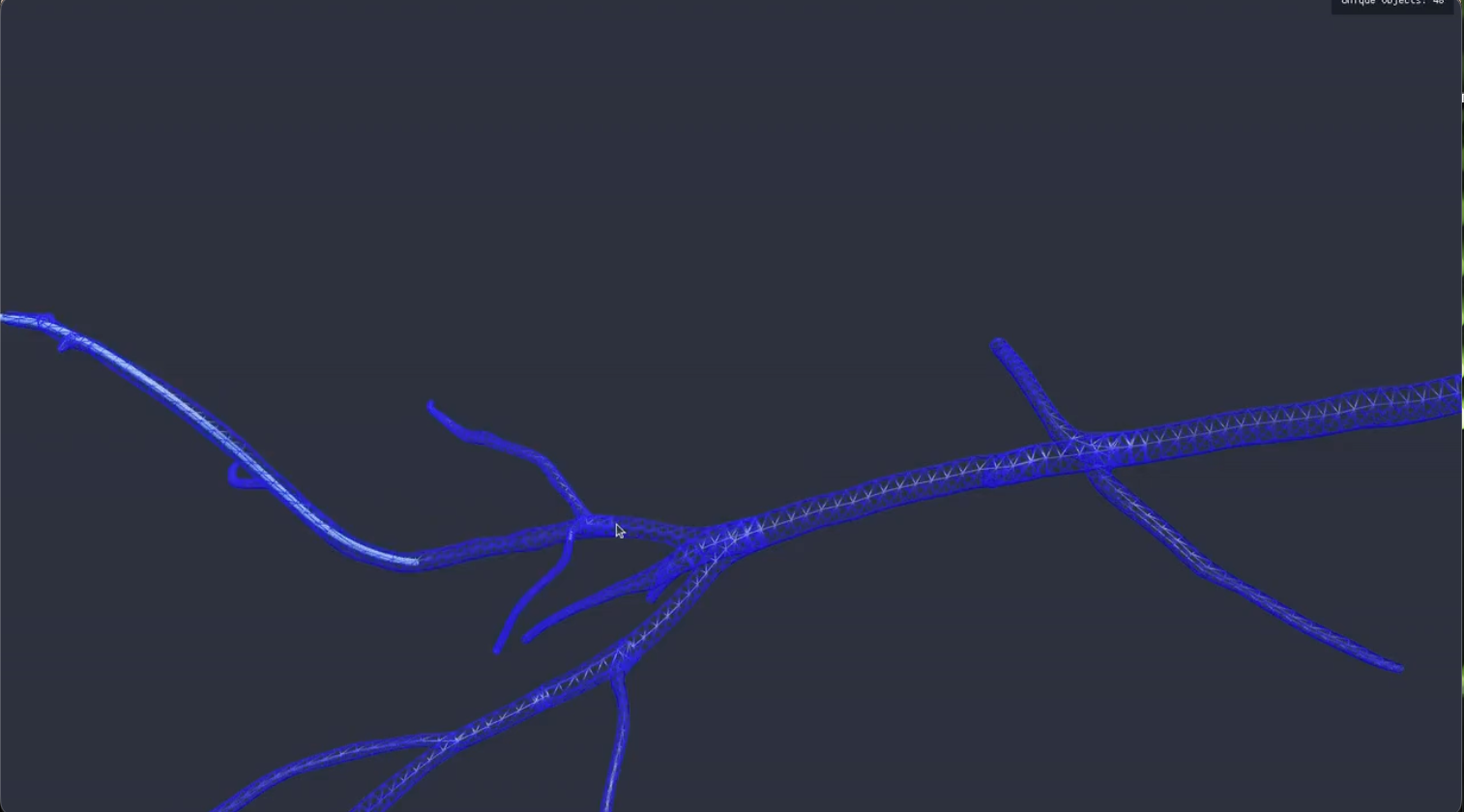
One workflow described by NVIDIA connects vascular anatomy with flexible instruments such as catheters and guidewires, simulated radiographic imaging and reinforcement learning. These elements represent the kinds of simultaneous changes a medical robot must handle when anatomy, instruments and visual feedback interact.
Combining known physics with learned behavior
The framework combines conventional simulation based on known physical rules with Cosmos-H-Dreams, NVIDIA’s real-time generative physics-simulation capability based on procedural data. The stated aim is to cover both established physical behavior and interactions that can be learned from data.
CMR Surgical and Cambridge Consultants, part of Capgemini, use Cosmos-H-Dreams to learn the physics of interactions implicitly during soft-tissue surgery procedures and generate patient-specific simulations. CMR Surgical has also contributed nearly 500 hours of anonymized clinical data from its Versius robotic surgical system to the Open-H Embodiment open dataset.
Those contributions link the simulation work to clinical data, but they do not amount to a claim of clinical validation. The announcement describes tools for modeling, training and evaluation; it does not establish that the resulting systems improve patient outcomes.
Digital twins are another use case
Johnson & Johnson MedTech is using Medical Physics Simulation and a Cosmos-based foundation model to build digital twins of its MONARCH endoluminal platform. NVIDIA says this work models complex anatomy and kidney-stone scenarios, giving the platform a virtual setting in which those conditions can be studied.
For developers, the concrete change is a faster and more scalable simulation path for medical-robotics training, evaluation and digital-twin work. The benchmark and described workflows support that development use case, while the available information does not support broader conclusions about clinical performance.
NVIDIA’s announcement therefore matters most before hardware is deployed: it expands the virtual environment in which medical-robotics teams can model anatomy, devices and difficult scenarios. The remaining trade-off is clear. Larger, faster simulation can support more development iterations, but it does not replace hardware testing or establish clinical results on its own.