
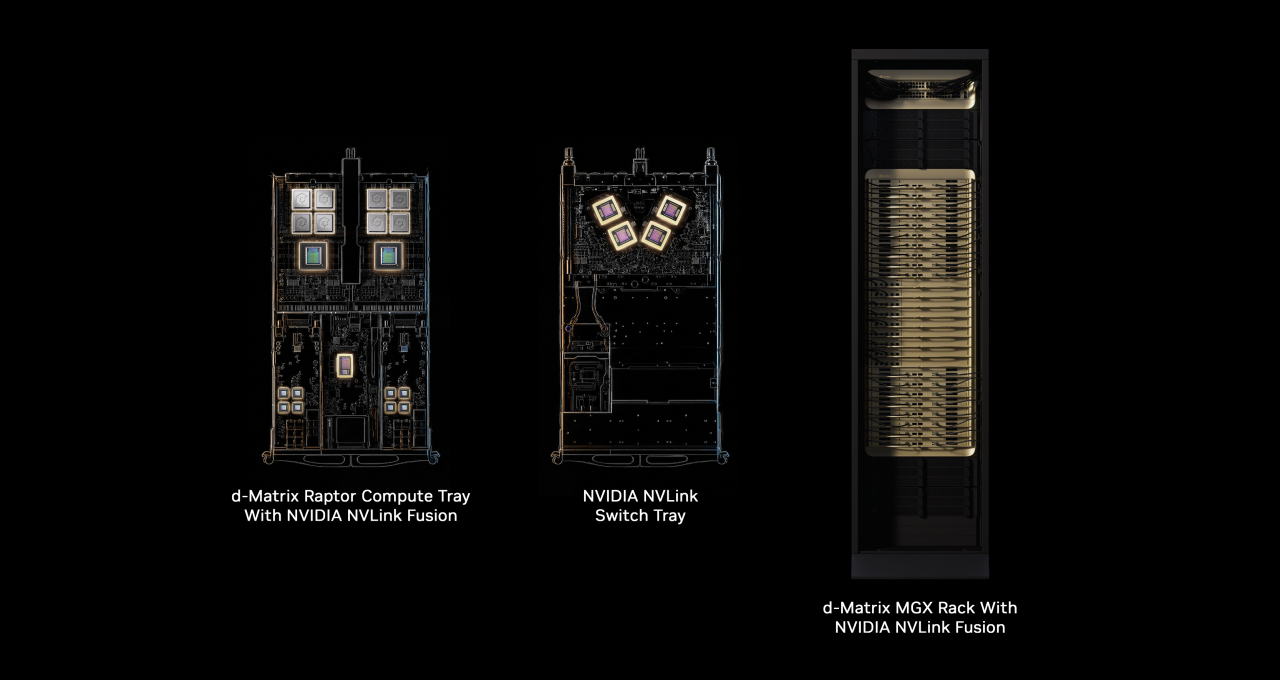
On September 10, 2026, NVIDIA said d-Matrix will adopt NVLink Fusion to connect its next-generation Raptor XPUs to NVIDIA’s AI infrastructure platform. The announcement concerns how Raptor will fit into a broader rack and networking architecture, making it relevant to data-center operators planning mixed AI systems. NVIDIA’s announcement presents the integration as an infrastructure decision rather than a performance result.
Raptor is being aligned with NVIDIA’s networking stack
Raptor will connect to NVIDIA’s NVLink scale-up network and its Spectrum-X scale-out network. d-Matrix also plans to integrate the XPU through NVIDIA’s MGX rack architecture. NVIDIA describes NVLink Fusion as an expansion of its platform to XPUs and CPUs, so the announcement is about the surrounding system as much as the processor itself.
That distinction matters for organizations planning AI-factory infrastructure. An XPU deployment requires more than a compute chip: NVIDIA lists networking, rack architecture, power, cooling, software and an established supply chain among the components needed to bring such a system into operation. Through NVLink Fusion, NVIDIA says d-Matrix can use validated MGX rack designs, along with MGX power, cooling and supply-chain infrastructure.
The immediate change is therefore at the integration layer. d-Matrix’s Raptor design is being aligned with an infrastructure foundation that NVIDIA presents as reusable across different processor types. This may simplify the architectural decision for teams already considering NVIDIA networking and MGX, while leaving the capabilities of the final Raptor systems to be demonstrated in deployment.
A common rack could support different processor types
NVIDIA says standardizing on a common rack should let data centers support GPUs, CPUs and XPUs without creating a separate rack architecture for each processor type. For operators, the proposed benefit is a smaller set of infrastructure patterns to accommodate. The announcement does not provide deployment figures, performance measurements or a schedule for Raptor-based systems.
d-Matrix plans to connect its XPUs in a single scale-up domain designed for high bandwidth and low latency. That wording describes an intended system configuration, not a reported benchmark. It should not be treated as evidence of a measured advantage over another platform. The practical question for prospective operators is how the design will behave once deployed and which configurations will be supported in operating data centers.
Raptor is intended to sit beside NVIDIA GPU systems
d-Matrix says its racks will operate alongside NVIDIA GPU-based systems such as Vera Rubin NVL72 for disaggregated inference. The planned integration also includes NVIDIA Vera CPUs, ConnectX-9 SuperNICs, BlueField-4 DPUs and Spectrum-X Ethernet.
Together, those elements point to a mixed infrastructure model. Raptor is being positioned as an XPU component that can share a data-center environment with NVIDIA GPU systems, rather than requiring a separate overall platform. That compatibility could matter to teams looking to combine different processor types within one rack strategy, but it does not establish that the systems will deliver equivalent performance or identical operating requirements.
For now, the concrete takeaway is architectural compatibility: NVIDIA and d-Matrix are describing a route to combine Raptor with NVLink, Spectrum-X and MGX resources while keeping GPUs, CPUs and XPUs within a common rack approach. Performance, scale and delivery remain open until the companies provide evidence from deployed Raptor-based systems.