
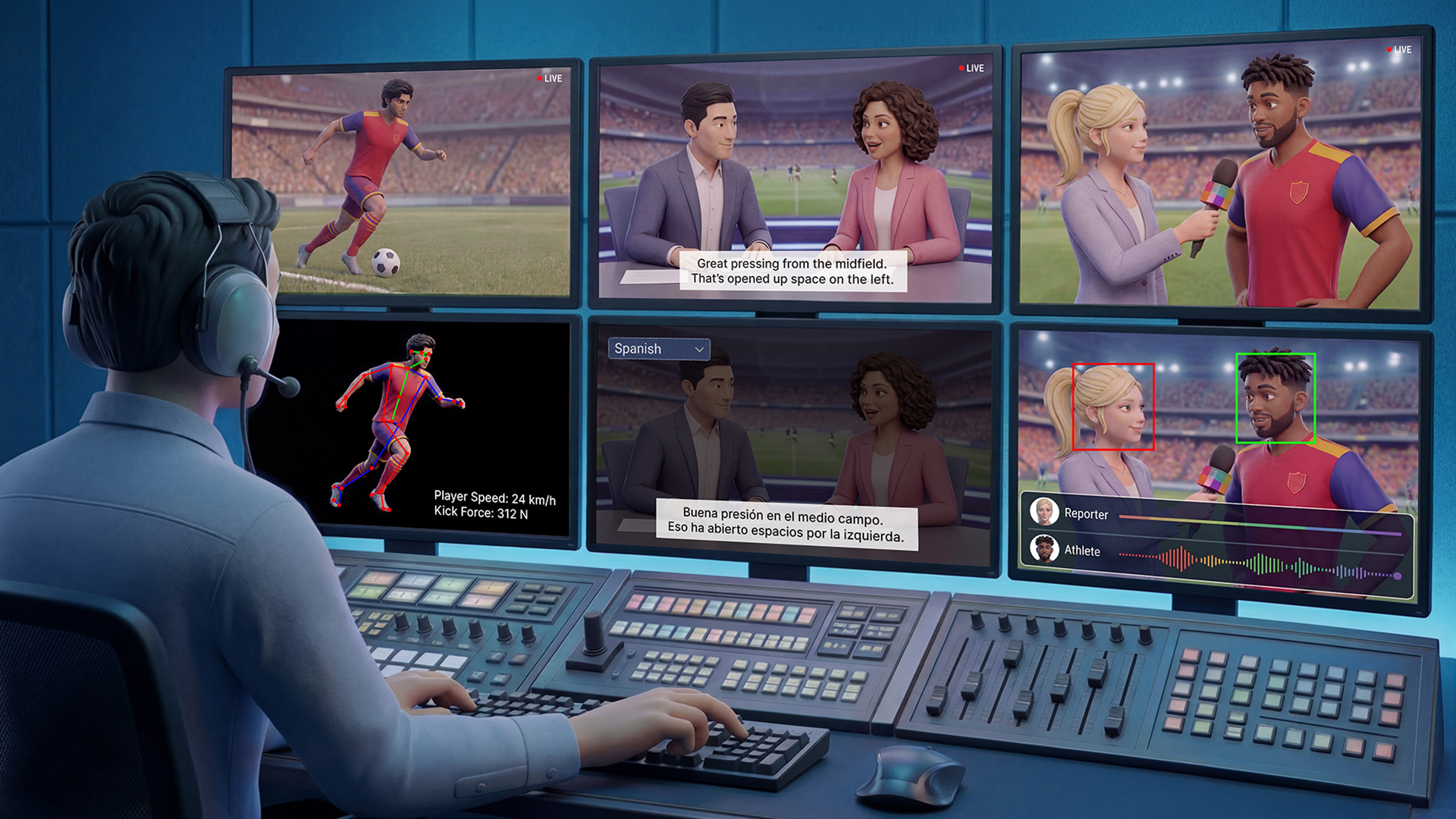
NVIDIA is expanding NVIDIA AI for Media at IBC 2026 in Amsterdam with GPU-accelerated SDKs, NVIDIA NIM microservices, playbooks and blueprints for media and entertainment workflows. The portfolio places synthetic-video verification alongside tools for live production, sports replay and content localization.
Verification moves closer to live-video workflows
The NVIDIA Synthetic Video Detector estimates the probability that a video sequence is authentic or generated by AI. NVIDIA reports 99.3% accuracy on text-to-video content and 97.7% on image-to-video content. Those figures come from NVIDIA and do not show how the detector performs across every source, format or manipulation method.
Several media systems are adopting the detector. Dalet is integrating it into a secure, cloud-hosted verification workflow for news organizations. TwelveLabs has announced general availability for Compliance by TwelveLabs, which uses the detector to provide image-level authenticity signals and confidence scores. Wowza will distribute it through the Wowza Video Intelligence Framework for real-time analysis of live video streams.
For newsrooms and streaming teams, the concrete change is the availability of authenticity signals within existing editorial and distribution workflows. A probability score can help prioritize review, but it does not replace editorial judgment or establish universal proof that a video is authentic.
Production tools cover tracking, replay and image quality
NVIDIA 3D Body Pose estimates human joint positions and angles in 2D and 3D from video captured by a single camera. Vizrt is using the technology in live virtual-studio environments, where tracked body movement can drive 3D lighting effects in real time.
NVIDIA also says Video Frame Generation can double or quadruple a video's frame rate by creating intermediate frames between original images. Ross Video is integrating the technology into Rio Replay for AI-assisted sports slow motion, with support for replays slowed by up to six times.
Video quality is another part of the update. NVIDIA Video Super Resolution now supports 10-bit video and is available through the NVIDIA Video Effects SDK and an NIM microservice. NVIDIA TrueHDR converts standard-dynamic-range video into high-dynamic-range output in real time, reaching approximately 2,000 nits.
Media Exchange Layer, integrated with NVIDIA Holoscan for Media, provides an open layer for exchanging video, audio and data between distributed media applications. That connects the individual processing tools to the wider infrastructure used to move media through production environments.
Sports models and localization target real-time delivery
NVIDIA's Sports Intelligence Playbooks cover data preparation, fine-tuning, inference, evaluation, optimization and deployment for multimodal sports models. In preliminary tests described by NVIDIA, multiple-choice accuracy rose from about 53% to 94%, while open-ended evaluation rose from about 5.7% to 66%. The announcement does not show how those results transfer to other datasets or production workloads.
NVIDIA is also integrating its Content Localization technologies into Holoscan for Media. The real-time workflows include subtitles, translated audio, dubbing, synchronized video and localized graphics, bringing several localization tasks into the same media-processing environment.
IBC 2026 runs in Amsterdam from September 11 through September 14, 2026, according to NVIDIA's announcement. NVIDIA's announcement therefore matters less as a single finished product than as a broad infrastructure push: media organizations are being offered more GPU-accelerated components and partner integrations for verification, production and distribution. The remaining trade-off is clear in the verification figures themselves: a detector can support a workflow, but its reported accuracy does not settle every authenticity question.