
By Clara Reed
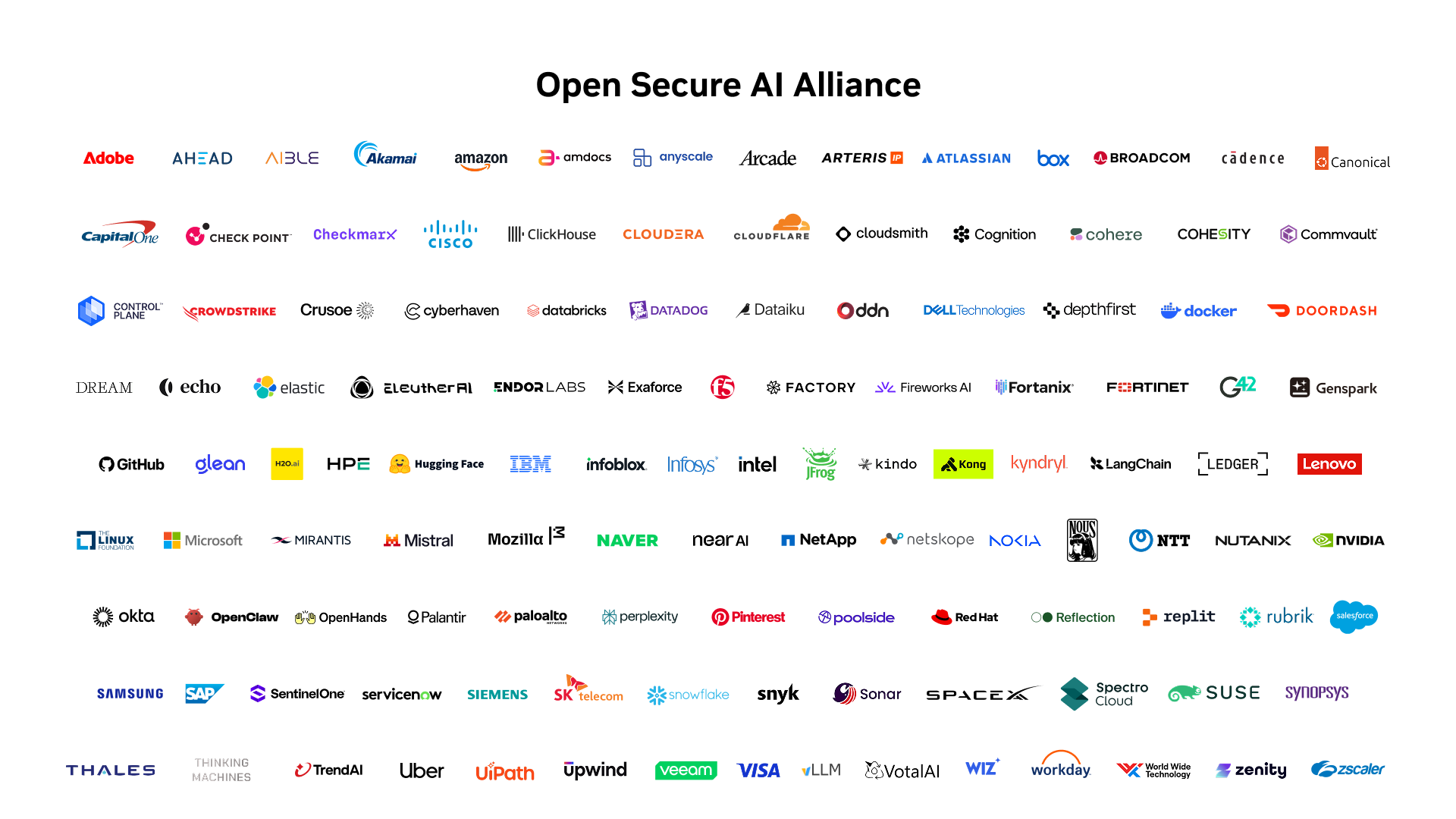
NVIDIA announced on July 27, 2026, the creation of the Open Secure AI Alliance, a coalition focused on developing and sharing open technologies for AI safety and cybersecurity. The group brings together companies, researchers and open-source foundations around a practical question: how can defenders inspect, adapt and control the AI systems increasingly involved in software development, security operations and infrastructure management?
The announcement names inaugural partners from across cloud computing, cybersecurity, enterprise software, open-source development and AI research. They include NVIDIA, Cisco, Cloudflare, CrowdStrike, GitHub, Hugging Face, IBM, Intel, Microsoft, Mozilla, Palo Alto Networks, Red Hat, Salesforce, ServiceNow, Siemens, Snyk, Visa, Wiz and Zscaler, alongside the Linux Foundation and other contributors.
Building an open defense stack
NVIDIA says the alliance will build on work from the Linux Foundation's Akrites initiative and the Open Source Security Foundation. Its stated focus includes vulnerability remediation and disclosure, secure coding workflows, multi-model scanning, identity, isolation and safeguards for AI agents.
This is broader than releasing a single security model. NVIDIA describes an agent as a complete system made up of a model, a harness, permissions, identity controls, guardrails, logs and evaluation processes. The alliance therefore aims to improve the layers around models as well as the models themselves. That distinction matters for organizations that need to understand what an AI agent can access, which tools it can invoke and how its decisions can be reviewed after an incident.
One early contribution is NVIDIA Labs Object-Oriented Agent, or NOOA, an open-source research framework available on GitHub. According to NVIDIA, NOOA is designed to help agent harnesses integrate with models in ways that make behavior easier to test, trace, audit and govern. It is presented as a research contribution rather than a finished enterprise security product.
Other examples show how the proposed stack could fit together. HPE is contributing to SPIFFE and SPIRE, technologies that provide cryptographic identity for workloads and services. Hugging Face has offered the Safetensors format to the PyTorch Foundation; the format is designed to store model weights without allowing remote code execution during loading. IBM and Red Hat are contributing Lightwell, which extends security across the open-source supply chain with digitally signed patches. Microsoft is contributing MDASH, a multi-model agentic scanning harness intended to coordinate specialized agents that discover, debate and prove exploitable bugs.
Why openness matters in cybersecurity
NVIDIA's argument is that defenders need more than access to closed frontier models. Open models and open harnesses can be inspected, adapted for local requirements and operated on infrastructure controlled by the organization using them. That can be important when sensitive incident data cannot be sent to an external service, or when a security team needs to examine and modify the controls around an AI workflow.
Open components can also make security research more distributed. A vulnerability scanner, evaluation dataset or agent harness that can be examined by multiple communities may receive more scrutiny and more specialized improvements than a system whose behavior is visible only through a service interface. The benefit is not automatic, however. Open code and open model weights still require maintenance, provenance checks, access controls and testing before they are trusted in production.
NVIDIA acknowledges the central trade-off. Open models can be misused, modified or stripped of safeguards, but keeping model weights closed does not eliminate misuse by determined attackers. The alliance's proposed answer is to combine openness with rules against malicious use, rigorous evaluation, rapid remediation and stronger controls across the full agent stack.
What the announcement means for security teams
For defenders, the most consequential part of the announcement is the emphasis on verifiability. An organization evaluating an AI security agent will need to ask more than how capable the underlying model is. It should also examine how the agent authenticates, what permissions it receives, whether tool calls are isolated, how prompts and outputs are logged, and whether its behavior can be tested against realistic attack scenarios.
The alliance could make those checks easier to standardize if its contributors publish interoperable tools and evaluation methods. It may also reduce dependence on one vendor by giving teams more choices over models, harnesses and deployment environments. At this stage, however, NVIDIA has announced the alliance and its direction, not a single integrated platform or a universal security certification. The practical value will depend on the quality of the projects that contributors release, the maintenance they receive and the extent to which the tools work together.
NVIDIA is also calling on policymakers and regulators to treat open AI models, security tooling, datasets, attack simulators and red-team frameworks as defensive assets. That position places the alliance in a wider debate about whether restrictions on open frontier systems could unintentionally concentrate defensive capabilities in a small number of closed providers.
The Open Secure AI Alliance is therefore best understood as an infrastructure and collaboration effort for the AI security ecosystem. Its immediate promise is not that open tools remove risk, but that more defenders may be able to inspect, test and improve the systems used to protect software and AI agents. That is a measurable ambition, and one that will ultimately be judged by the transparency and reliability of the projects delivered under the alliance's name.