
Anthropic has opened a research preview of the Model Hardware Standard (MHS) to an initial group of scientific research laboratories and advanced manufacturers, according to an announcement published on August 27, 2026.
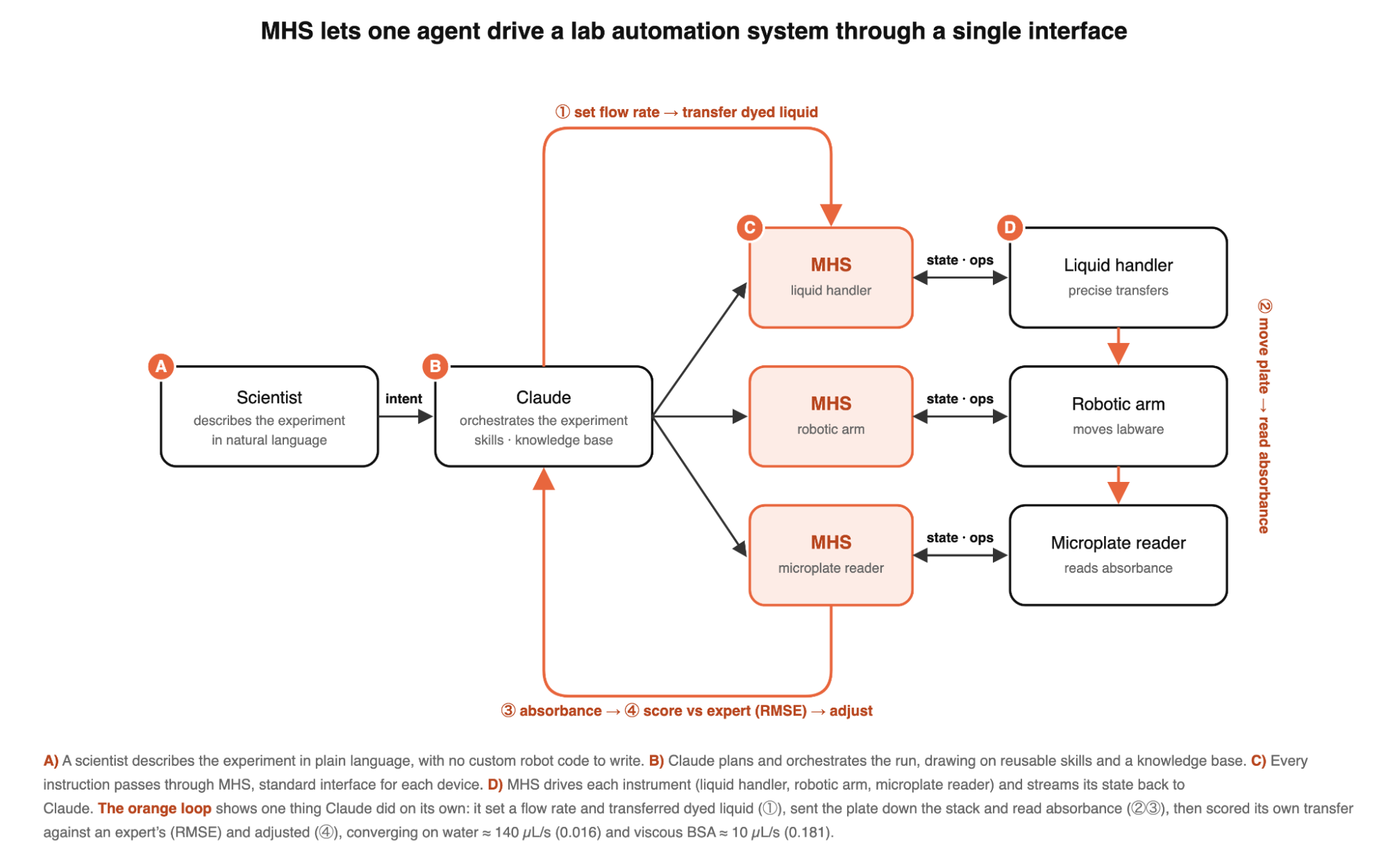
The company says MHS allows AI agents to run multiple laboratory and manufacturing instruments in parallel. The examples named in the announcement include microscopes, liquid-handling robots and robotic arms. Anthropic also says the standard works with any device that has a programmable interface.
Anthropic links the standard to a reduction in hardware integration time. Work that typically takes weeks or months, the company says, can be completed in hours or minutes with MHS. The preview is therefore focused on coordinating equipment through software so that several devices can be used together by an AI agent.
One proof of concept came from Genentech researchers. Using MHS, they coordinated a liquid-handling robot, a robotic arm and a microplate reader to automate a BCA assay. The example shows the standard operating across different types of laboratory equipment within one automated process.
Researchers at Carnegie Mellon University used MHS for dose-response curve experiments. Anthropic reports that the experiments ran approximately three times faster than before. The announcement does not provide a wider performance benchmark, but it identifies the result as an early demonstration of the standard’s use in scientific research.
Taken together, the reported examples give MHS a defined scope: parallel control of programmable instruments, shorter hardware-integration timelines and early demonstrations in laboratory automation. Anthropic has made the preview available to a first group of research laboratories and advanced manufacturers, with Genentech and Carnegie Mellon among the organizations named in its announcement.