
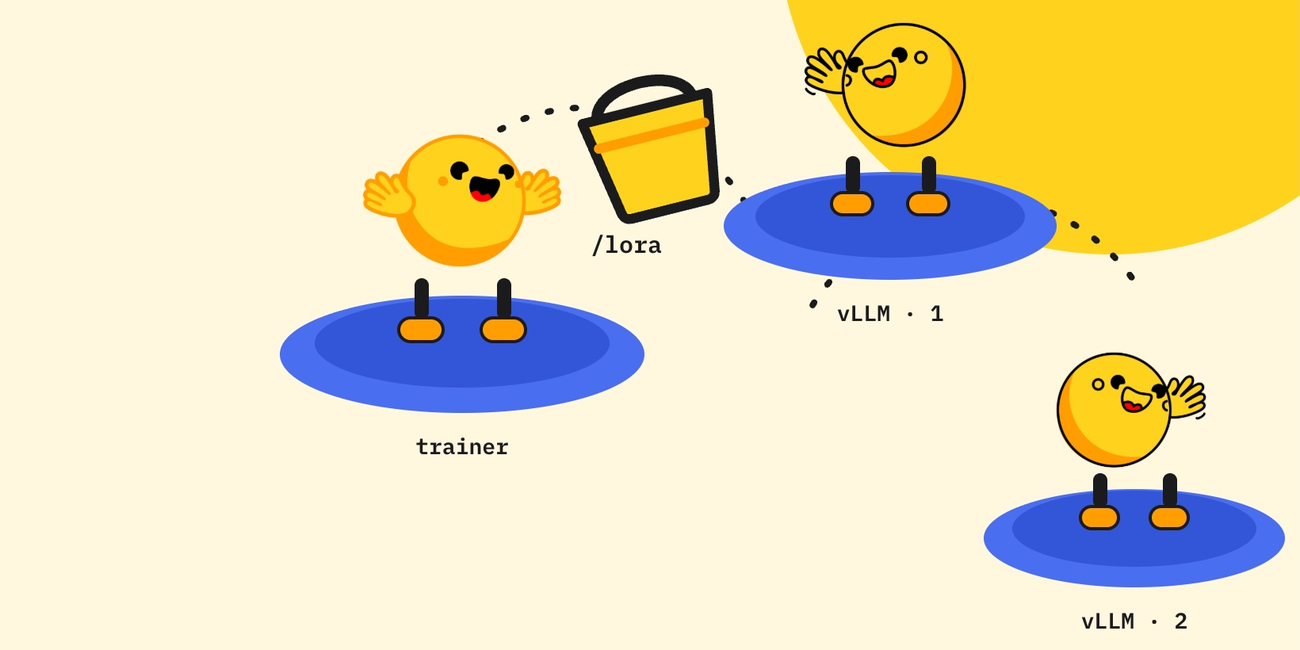
Hugging Face has described a way to move reinforcement-learning policy updates into vLLM without synchronizing the full model. In an article published on September 10, 2026, the company says TRL v1.14's AsyncGRPOTrainer can train a LoRA adapter and synchronize only that adapter with vLLM. The approach targets distributed training setups where the training process and inference replicas run as separate jobs.
Smaller updates between separate jobs
For a 1.5-billion-parameter model, Hugging Face puts a rank-1 adapter at a few megabytes, compared with about 3 GB for the complete model. The policy update passed between jobs is therefore the adapter, while the vLLM replicas serve the base model with published adapters. That reduces the amount of model state involved in each synchronization, although the reported result remains tied to the described recipe and deployment.
The demonstration splits the system into one training job and two vLLM jobs, each running on a separate machine. All three mount the same storage bucket at the same path. The adapters can move between jobs through shared storage, and both vLLM replicas can read the versions published by training.
At each synchronization, the trainer writes the adapter under output_dir/.vllm_lora/trl-policy-v{N} and publishes it through an atomic rename. It then sends the path to the vLLM /v1/load_lora_adapter endpoint. This sequence gives the loading request a named, versioned adapter after publication has completed.
Proxy routing and adapter capacity
The proxy handles the coordination layer. It adds an Authorization: Bearer header containing the Hugging Face token to requests sent to the exposed job ports. Completion requests are routed to the replica likely to have the relevant KV-cache prefix, while adapter-loading, pause, and resume requests are broadcast to every replica.
Each vLLM replica uses one GPU and the vllm/vllm-openai 0.27.1 image in the demonstration. With max_staleness=4, the configuration reserves six vLLM adapter slots: one for the current policy, four for previous versions, and one additional slot during replacement. Adapter-slot capacity is therefore part of the deployment design, alongside the shared bucket and proxy.
What the reported timing shows
Hugging Face reports that five executions of the same recipe for 500 steps fell from 3 hours 27 minutes to 53 minutes. Those figures describe the published setup rather than an independently reproduced benchmark here. They show the potential payoff of keeping synchronization focused on small adapters and separating training from serving, but they should be read as a result for that configuration, not as a universal timing guarantee for every AsyncGRPO workload.
For teams evaluating distributed reinforcement-learning infrastructure, the concrete change is a versioned adapter handoff through shared storage, coordinated across vLLM replicas. The trade-off remains operational: the pattern needs a proxy, shared storage, adapter slots, and synchronized control requests. Hugging Face's report presents a measured infrastructure pattern, not a promise that every workload will complete in 53 minutes.